


The Silent Problem in AI
AI is reshaping how software interacts with people. But most teams only measure what happens inside the model, latency, token usage, accuracy, not what happens after.
Your AI can execute flawlessly from a system perspective and still fail the customer silently.
Observability, a backbone of modern engineering, was designed to track machines. But AI introduces a new variable: human interpretation.
A model can respond perfectly according to its parameters while still delivering a poor experience for the user on the other side of the screen.
Traditional dashboards light up green while customers quietly abandon the product.
That’s the blind spot customer-centric observability aims to close.
Definition: What Is Customer-Centric Observability?
It’s an evolution of the AI observability platform, extending its focus from system health to human satisfaction, intent alignment, and perceived value.
This approach recognizes that every log line or token trace represents a real user’s attempt to solve something. And that’s what needs to be observed, measured, and improved.
Why Traditional Observability Fails AI Teams
Most AI teams still rely on inherited infrastructure metrics. They can detect latency spikes, monitor cost per call, or catch system errors.
But the majority of AI failures don’t happen in the logs. They happen in the gap between model output and user intent.
Consider three invisible failures:
A copilot that produces confident nonsense.
An agent that misunderstands a question and loops endlessly.
A chatbot that resolves tickets but frustrates customers through tone or context.
Each looks “healthy” in monitoring dashboards. None would appear in traditional alerting systems.
AI fails silently and when it does, so do your customers.
The Shift Toward Experience-Level Visibility
AI observability platforms are starting to evolve from system-centric to experience-centric monitoring.
To understand that shift, think in layers:
Model Layer: Latency, token cost, accuracy.
Interaction Layer: Prompts, responses, retries, grounding.
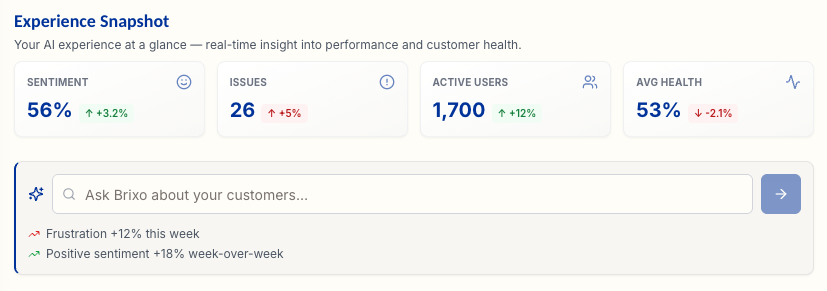
Experience Layer: Sentiment, frustration, resolution, satisfaction.
Most companies stop at layer two.
But the real insight lives in layer three — understanding how each interaction feels to the customer.
Visibility shouldn’t end with “Did it work?” but extend to “Did it help?”
The Four Pillars of Customer-Centric Observability
1. Trace Every Interaction
Every conversation, completion, or query should be tied to the user and context that produced it. The goal is not more data but connected data: linking traces, inputs, and outcomes so teams can analyze who was affected by what.
2. Interpret Sentiment and Outcome
Modern telemetry includes emotional signals. Detecting frustration, satisfaction, or confusion is the new form of uptime. A technically successful completion that leaves the user irritated is still a failure.
3. Map Experience to Business Impact
When you correlate conversation quality with metrics like retention or NPS, you transform abstract AI behavior into measurable business outcomes. This is where product and CX finally share the same language.
4. Enable Cross-Team Understanding
Engineering needs to know why the model failed. Product needs to know where customers dropped off. CX needs to know who to reach out to.
Customer-centric observability connects all three through shared visibility — a single source of experiential truth.
How It Changes the Way Teams Work
Customer-centric observability isn’t just a dashboard upgrade; it’s a cultural shift.
In the old model:
Engineering owned observability.
Product owned adoption.
CX owned the fallout.
In the new model, these functions share the same window into how AI performs for real people.
When telemetry connects directly to experience, every team gains clarity:
Engineering can prioritize real user impact, not just errors.
Product can design for success, not just usage.
CX can act before frustration turns into churn.
It turns observability from a defensive practice into a proactive team sport: from detecting failure to enabling better experiences.
How It Differs From AI Monitoring or Analytics
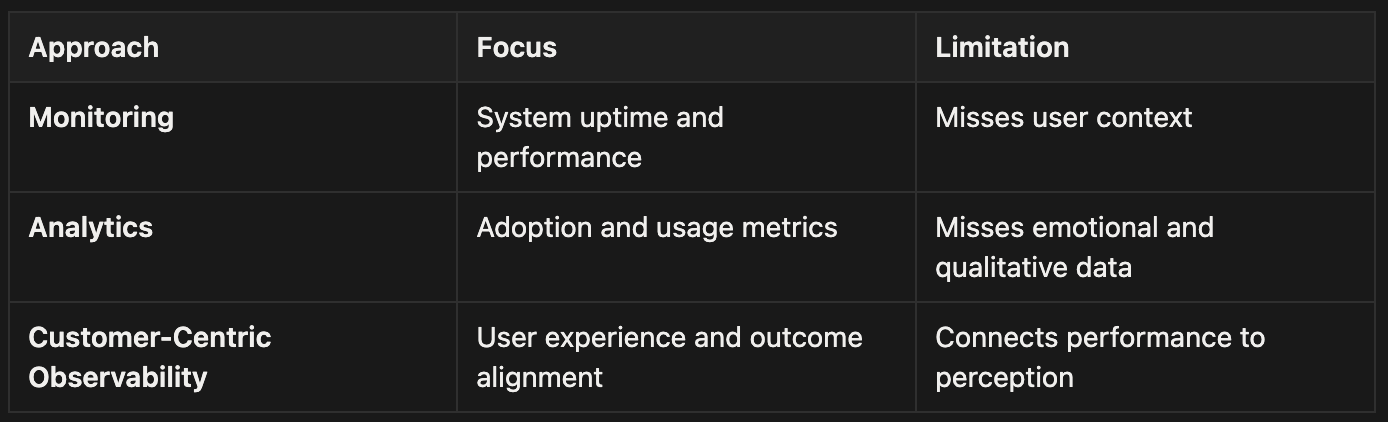
Monitoring tells you if your system works.
Analytics tells you if people are using it.
Customer-centric observability tells you if they’re happy with it.
This is the difference between optimizing for the model and optimizing for the human.
The Future of Observability Is Human
The next decade of AI products will compete not on who has the best model, but on who delivers the best experience.
Just as DevOps matured into observability, the AI era is maturing into something like Experience Ops, where customer trust is monitored, measured, and improved through data. (We’ll see if the name sticks 😄)
Customer-centric observability is the foundation of that shift.
Because in the end, success isn’t when the dashboard is green — it’s when the customer smiles.
Hey, great read as always. What if the 'confident nonsense' AI actually thinks it's profound, and our green dashboards just agre?