AI products generate the most detailed customer behavior data in the history of software. Every conversation is a record of what a customer wanted, how they tried to get it, where they got confused, and whether they succeeded or gave up.
That data sits in agent logs that nobody reads and product teams shipping AI features are making decisions without it.
They know usage is up. They know session counts are growing. They know message volume is increasing.
What they don’t know is whether any of it is working for the people using it.
The intelligence is trapped inside the conversations.
A customer who tells your AI “I don’t understand, can you try explaining it a different way” is giving you a direct signal about your product’s performance.
A customer who rephrases the same request four times is telling you something specific about where the experience breaks down.
A customer whose tone shifts from enthusiastic to terse over the course of a session is flagging a problem in real time.
None of this shows up in a product analytics dashboard because these long-standing products can only see events a.k.a. button clicks.
Not in your observability tools either. The observability platform confirms the agent responded correctly both times, for the customer who left happy and the customer who left frustrated. Same grade on the engineering scorecard.
The irony is that older SaaS products generated far less behavioral data, and teams had better visibility into what was happening. A button click told you something clear. A form submission had a defined outcome. A funnel had stages you could measure. The analytics matched the product.
AI conversations contain richer information about customer intent, satisfaction, and outcomes than any button click ever did. But the tools that exist today don’t know how to read it. So teams export logs, open spreadsheets, and start scrolling. Or they write SQL queries against message tables, trying to extract meaning from data that wasn’t designed to be queried that way.
The product data is there. It’s more detailed and more valuable than anything that came before it. The gap isn’t in the data. It’s in the ability to make sense of it.
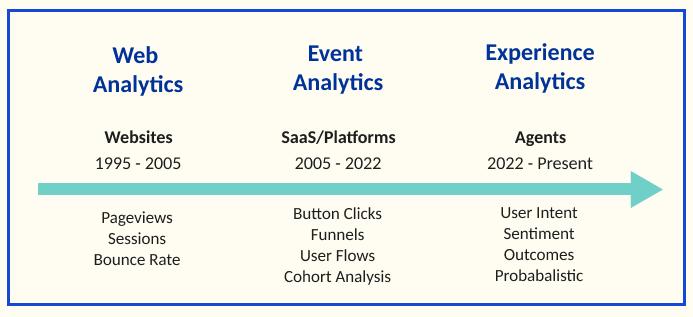
We’re facing an inflection point in the “analytics” world, where the new modalities are demanding a different approach.
We call it Experience Analytics: analytics that track the entire journey from users initial intent to their final outcome and provide insight into the ups, downs and breaks within the journey that dictate if the customer is coming back for more.